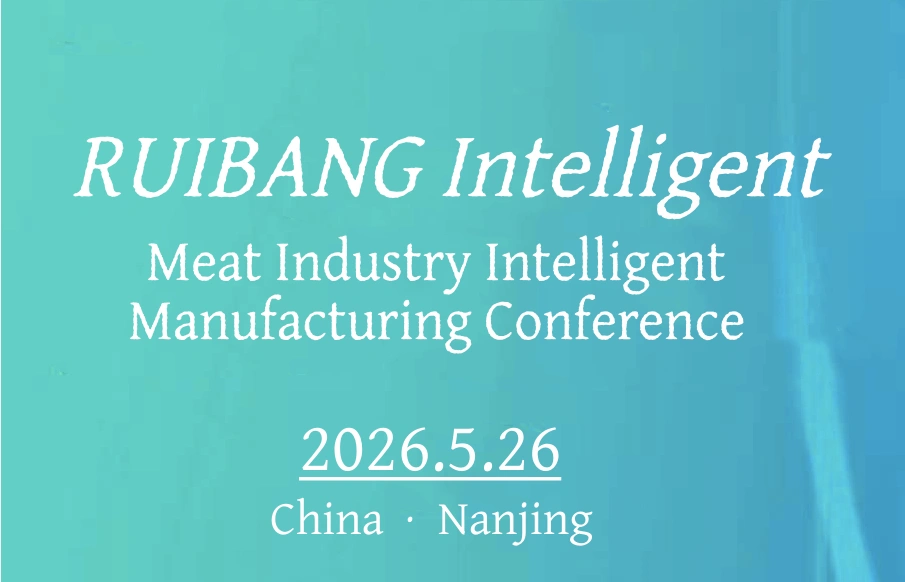
From May 25th to 27th, 2026, the highly anticipated "Ruibang Intelligent - Meat Industry Intelligent Manufacturing Conference" was grandly held in Nanjing.This conference was hosted by the China Meat Association, gathering leaders from government departments, experts from research institutions, representatives of leading domestic equipment manufacturers and meat processing enterprises, totaling over 180 industry elites.
The conference focused on the core topics of "AI Empowerment - Breaking Through in Manufacturing" and "Intelligent Future - Opportunities and Breakthroughs in the Full Chain Intelligence of Meat Processing". Through policy interpretation, standard initiation, technology sharing and roundtable discussions, it deeply analyzed how the meat industry can utilize digital and intelligent means to overcome development bottlenecks and achieve high-quality development under the "15th Five-Year Plan" framework.
As one of the significant outcomes of this conference, two group standards, namely "Technical Specifications for Equipment Configuration of Cattle Slaughtering Lines" and "Technical Specifications for Equipment Configuration of Sheep Slaughtering Lines", have been officially launched. This marks a solid step forward in the standardization construction of livestock and poultry slaughtering equipment in China, which will effectively promote the standardization and branding development of the industry and lay a solid foundation for the "going global" of domestic equipment.
Technological breakthrough
1. Intelligent robots solve the problem of "human reliance"
In response to the long-standing pain points in the traditional slaughtering and processing stages such as "inability to see clearly, inability to cut accurately, and difficulty in removing bones", research institutions including Henan University of Science and Technology have showcased cutting-edge technologies such as three-dimensional perception of livestock carcasses, adaptive cutting, and autonomous bone removal robots. These achievements are gradually breaking the situation where high-end equipment has long relied on imports. The application of domestic bone removal robots and dual-hand collaborative processing robots has significantly improved the output rate and safety.
2. Full-chain Digitalization and AI Quality Control
The consensus among enterprises is to move from "single-machine automation" to "full-chain digitalization and intelligence". Representatives from enterprises such as Qingdao Shupu and Nanjing Linling shared how they utilized digital twins and AI algorithms to break through "information silos". Through 3D vision and AI online grading, enterprises not only achieved "instant" traceability but also could achieve precise predictions and cost reduction and efficiency improvement in the breeding, slaughtering, and cutting processes.
3. Food Safety and Intelligent Inspection
Shanghai Taiyi and other enterprises showcased intelligent inspection solutions based on X-ray fluoroscopy and AI vision, which can accurately identify and eliminate physical hazards in products on the production line. At the same time, combined with the intelligent hygiene cleaning system of the Internet of Things, it also provides digital and intelligent protection for the biological safety of food factories.
The successful holding of the 2026 Intelligent Manufacturing Conference in the Meat Industry not only showcased the latest achievements of intelligent manufacturing in the sector, but also strengthened the confidence of the entire industry in driving high-quality development through technological innovation. With the deep implementation of AI technology and intelligent equipment, the Chinese meat industry is accelerating its progress towards a new era characterized by human-machine collaboration, data-driven operations, and green safety.