Meat hooks play a vital role in the meat processing industry, allowing for the effective handling, storage, and movement of carcasses. Whether you run a small butcher shop, a large slaughterhouse, or a food processing plant, choosing the appropriate meat hook is essential for upholding hygiene standards, streamlining workflow, and ensuring safety.
When choosing the appropriate slaughterhouse hooks, one needs to consider factors such as material, load-bearing capacity, specifications, usage scenarios and compliance.
Qingdao ZBHT Machinery has nearly 20 years of experience in manufacturing slaughterhouse equipment. Our hooks are built for strength, durability, and hygiene, meeting the needs of both small-scale and large-scale meat processors.We can tailor-make hooks specifically for your slaughterhouse according to your individual requirements.
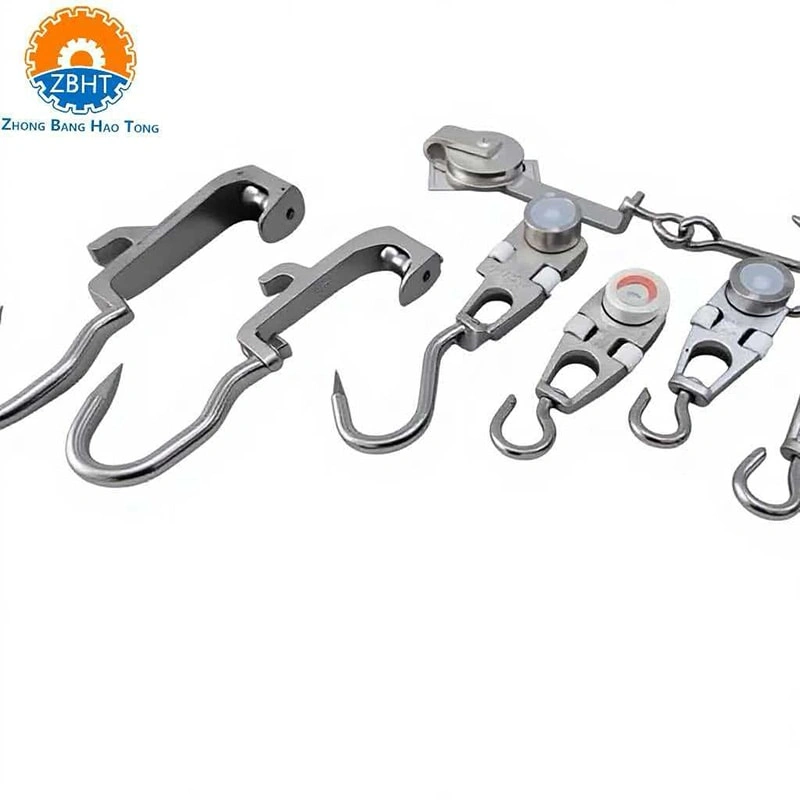
Classification by material:
304 stainless steel: Food grade, corrosion-resistant, easy to clean, no rust, suitable for harsh environments such as cold storage, smoking, and air-drying.
Galvanized carbon steel: Lower cost, suitable for short-term or non-direct contact with food scenarios, but prone to rust over time.
Classification by Hook Type
We categorize slaughterhouse hooks based on design, material, and function.
1.The Standard Gambrel Hook (The Backbone of the Line)
Design: A horizontal bar with an inverted "V" or central eyelet. Two curved ends hold the hind legs.
Use: Hanging whole carcasses of pigs, sheep, and small cattle during bleeding, scalding, and skinning.
Advantage: Perfectly balanced; spreads the legs for easy dressing.
2. Liver Retractor / Spreader Hook
Design: A long rod with a sharp, curved hook on one end and a handle or counterweight on the other.
Use: Specifically for pulling and holding the diaphragm/liver to access the esophagus.
Advantage: Reduces risk of bile spillage (tainting meat).
3. S-Hook (Double Hook / Balancer Hook)
Design: Shaped like the letter "S" – a large lower curve and a smaller upper curve.
Use: Connecting a carcass to a rail trolley, or hanging primals (shoulders, hams) in chillers.
Advantage: Quick to attach/detach; ideal for quartering.
4. Scissor Hook (Wing Hook)
Design: Two independent curved prongs that look like open scissors.
Use: Hanging carcasses from the Achilles tendon, particularly for beef.
Advantage: Deep grip on the tendon; prevents accidental slipping during heavy lifting.
5. Scalding & Shaving Hook
Design: Shorter, thick-gauge steel with a blunt tip.
Use: Pigs. Moving carcasses through the scalding tank and onto the dehairing machine.
Advantage: Heat-resistant handle (if rubber coated); blunt tip prevents hide damage.
6. Viscera Inspection Hook
Design: A small, sharp, stainless steel hook with a plastic or wooden handle.
Use: Pulling the stomach, liver, and pluck set for veterinary inspection.
Advantage: Sanitary (easy to sterilize); ergonomic for repetitive motion.
7. Rail Trolley Hook (Rails Hook / Carcass Transfer Hook)
Design: A heavy-duty J-hook bolted directly to a rail trolley wheel.
Use: Fixed position on the overhead conveyor rail.
Advantage: High weight capacity (up to 1,000+ kg for beef).
How to Select the Right Hook for Pigs, Cattle, and Sheep
Not all hooks work for all species. Here is the species-by-species selection strategy.
1.For Cattle (Beef) – The Heavyweight
Challenge: Extreme weight (300–450+ kg). Safety is the #1 priority.
Best Hooks:
Scissor Hooks: Mandatory for Achilles tendon hanging. They grip powerfully without crushing the tendon.
Heavy-Duty Rail Trolley Hooks: Must be forged, not welded. Use Grade 80 or 100 chain hooks if a chain is involved.
Key Specs: Stainless Steel 304 or 316. Minimum working load limit (WLL) of 500kg. Avoid sharp points near meat cuts.
2.For Pigs (Pork) – The Process-Heavy Line
Challenge: Pigs move through multiple zones: scalding (hot/wet), dehairing (abrasive), and chilling (cold).
Best Hooks:
Gambrel Hooks: For hanging both hind legs post-scalding.
Scalding Hooks: Thick, blunt, and often with a heat-resistant rubber grip.
Steel Type: Galvanized steel is acceptable in wet areas, but Stainless Steel is preferred for final chilling to prevent rust contamination.
Key Specs: Smooth finish. No barbs that could tear subcutaneous fat.
3.For Sheep (Lamb/Mutton) – The Delicate Balance
Challenge: Thin skin, low fat cover, and small joints. Bruising destroys value.
Best Hooks:
Small Gambrel Hooks (Mini): Narrow bar spread (20-30cm) to avoid over-stretching the legs.
Light S-Hooks: For hanging racks and loins.
Nylon/Plastic-Coated Hooks: Essential for premium lamb. The coating prevents "hook burn" (grey/black marks on the white fat).
Key Specs: Light gauge wire (8-10mm thickness). Plastisol (PVC) dipped coating is highly recommended.
Final Professional Advice for Procurement
Match the Material to the Zone:
Hot/Bleeding Area: Stainless steel (hygienic).
Scalding Area (Pigs): Heat-treated steel.
Chiller (All): 304 Stainless steel (resists condensation rust).
Never use "Sharp" on Carcasses: Sharp hooks are for viscera/offal only. For meat, use semi-blunt tips to puncture less, not cut.
Ergonomics for Workers: For manual handling (e.g., viscera hooks), invest in ergonomic handles to reduce carpal tunnel injuries among your staff.
We supply the full range of ISO-certified slaughterhouse hooks. Please tell us your daily throughput (pigs/cattle/sheep) and we will recommend a hook set tailored to your rail system.