The cattle slaughtering line is an automated assembly line equipment system used for large-scale and standardized processing of beef cattle. Its core processes include fainting and bloodletting, skin and dirt removal, splitting in half and cutting, cooling and acid removal, etc., aiming to improve efficiency and ensure meat quality and food safety . Its core processes include stunning and bleeding, skinning and cleaning, splitting and segmentation, cooling and acidification, etc., aiming to enhance efficiency, ensure meat quality and food safety.
Qingdao Zhongbang Haotong Machinery has been engaged in modern slaughterhouse design, technology develop,manufacturing, installation and commissioning for nearly 20 years. All products are implemented in accordance with the requirements of the ISO9001:2008 quality system. Product quality meets national requirements and EU standards.
Core process flow and key equipment
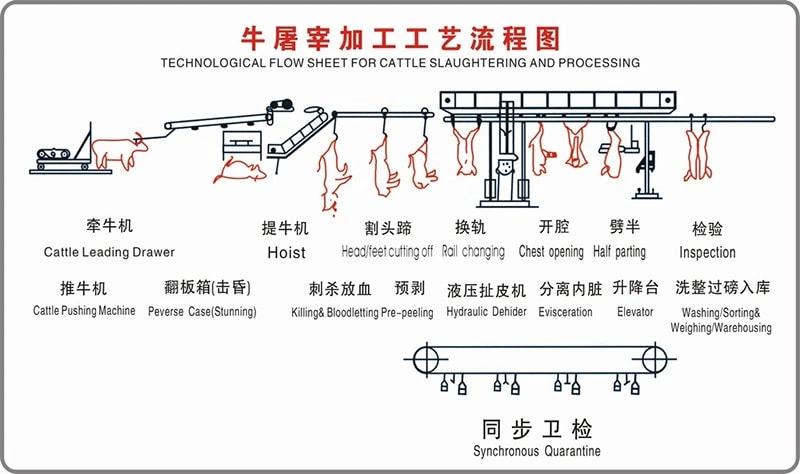
The modern cattle slaughtering line adheres to strict hygiene and operation standards. Its process flow is closely linked and mainly includes the following core links: The process flow is closely linked and mainly includes the following core steps:
Pre-slaughter treatment and stunning bleeding: After the live cattle arrive, they need to undergo quarantine and rest to reduce stress. Then, through photoelectric electroshock or three-point electroshock methods, the cattle are stunned, and immediately slaughtered and bled. This process must be thorough to ensure meat quality and shelf life.
Skinning and removal of head and hooves: After stunning and bleeding, the cattle are lifted and fixed. Using hydraulic skinning machines or mechanical skinning machines, the skin is completely removed. This replaces traditional manual methods, increasing efficiency and reducing pollution. Then, the head and hooves are removed.
Opening the chest and handling internal organs: Along the sternum, the chest cavity is opened to remove the internal organs. This process requires strict distinction between red organs (heart, liver, lungs) and white organs (stomach, intestines), and separate treatment to prevent cross-contamination.
Dressing and splitting: After removing the internal organs, the carcass is rinsed and trimmed to remove residual hair, blood, etc. Then, a bridge-type splitting saw or hydraulic splitting machine is used to precisely split the entire beef carcass along the spine into two halves, facilitating subsequent cooling, acidification and segmentation.
Cooling and acidification: The split beef carcasses are immediately sent to the cooling room, where they undergo 24-48 hours of cooling and acidification at 0-4°C. This process allows the lactic acid in the meat to decompose, making the meat more tender and flavorful, which is a key step in modern slaughtering techniques.
Fine segmentation and packaging: After acidification, the half carcasses enter the segmentation workshop, transported by conveyor belts to various stations. Operators or intelligent equipment perform fine segmentation according to the parts, producing cuts such as tenderloin, sirloin, brisket, and tendon. The segmented meat is trimmed, graded, weighed, and then vacuum or modified atmosphere packaged, with traceability labels attached.
Core advantages of modern slaughtering lines
Compared to traditional manual slaughtering, modern beef slaughtering lines have significant advantages in terms of efficiency, safety and quality:
Significant improvement in production efficiency: Automated production line operations can achieve continuous production, with a single shift capacity of several hundred cattle, far higher than manual slaughtering, and can reduce the demand for labor by 60%.
Full control of food safety: From entry quarantine to final packaging, the entire process adopts standardized and aseptic operations, equipped with metal detection, X-ray foreign object detection and other equipment, effectively preventing cross-contamination and achieving full traceability.
Improvement in meat quality and added value: Scientific stunning, bleeding and cooling and acidification processes can minimize stress on the cattle and lock in the meat juices and nutrients. Fine segmentation can be carried out according to the characteristics of different parts for processing, meeting diversified market demands and enhancing product added value.
Industry development trends and policy orientation
Currently, the beef slaughtering industry is developing towards intelligence, greenness and standardization:
Technological intelligent upgrading: AI vision recognition, Internet of Things (IoT) and big data technologies are being applied to automatically identify meat quality, optimize cutting parameters, and implement full-process monitoring and traceability of production data, promoting the slaughtering line to evolve into an "intelligent factory".
Green and sustainable development: To respond to environmental protection requirements, slaughtering lines are beginning to adopt energy-saving motors, waste heat recovery, closed water systems and no-water depilation technologies to reduce energy and water consumption and reduce environmental pollution.
Policy promotion of centralized slaughtering: To ensure food safety, many regions are actively promoting cattle centralized slaughtering.